Legacy
میراث
Classical Islamic civilization
Robert Wisnovsky, a scholar of Avicenna attached to McGill University, says that "Avicenna was the central figure in the long history of the rational sciences in Islam, particularly in the fields of metaphysics, logic and medicine" but that his works didn't only have an influence in these "secular" fields of knowledge alone, as "these works, or portions of them, were read, taught, copied, commented upon, quoted, paraphrased and cited by thousands of post-Avicennian scholars—not only philosophers, logicians, physicians and specialists in the mathematical or exact sciences, but also by those who specialized in the disciplines of ʿilm al-kalām (rational theology, but understood to include natural philosophy, epistemology and philosophy of mind) and usūl al-fiqh (jurisprudence, but understood to include philosophy of law, dialectic, and philosophy of language)."
Middle Ages and Renaissance
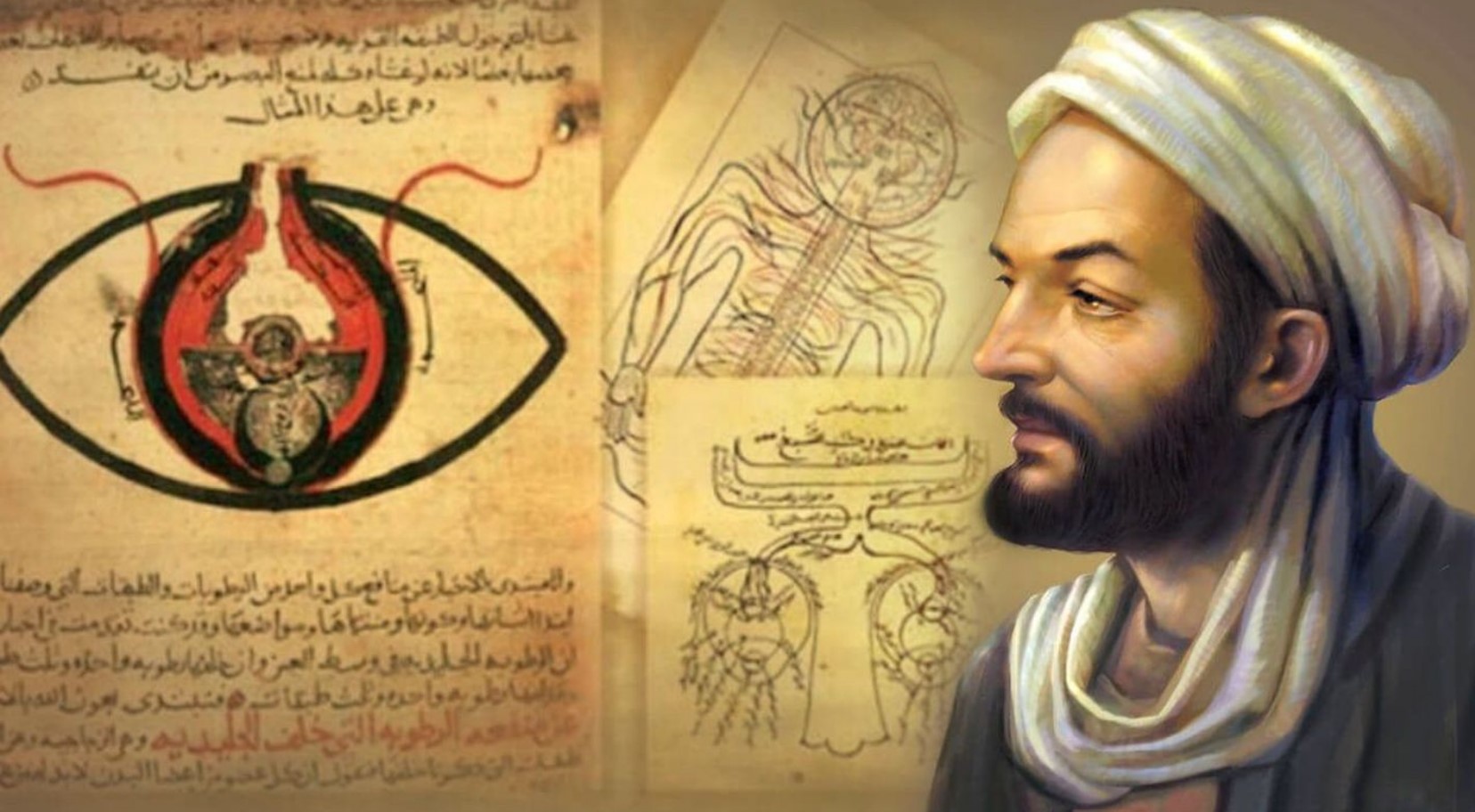 As early as the 14th century when Dante Alighieri depicted him in
Limbo alongside the virtuous non-Christian thinkers in his Divine
Comedy such as Virgil, Averroes, Homer, Horace, Ovid, Lucan, Socrates,
Plato and Saladin. Avicenna has been recognized by both East and West
as one of the great figures in intellectual history. Johannes Kepler
cites Avicenna's opinion when discussing the causes of planetary
motions in Chapter 2 of Astronomia Nova.
As early as the 14th century when Dante Alighieri depicted him in
Limbo alongside the virtuous non-Christian thinkers in his Divine
Comedy such as Virgil, Averroes, Homer, Horace, Ovid, Lucan, Socrates,
Plato and Saladin. Avicenna has been recognized by both East and West
as one of the great figures in intellectual history. Johannes Kepler
cites Avicenna's opinion when discussing the causes of planetary
motions in Chapter 2 of Astronomia Nova.
George Sarton, the author of The History of Science, described Avicenna as "one of the greatest thinkers and medical scholars in history" and called him "the most famous scientist of Islam and one of the most famous of all races, places, and times". He was one of the Islamic world's leading writers in the field of medicine. Along with Rhazes, Abulcasis, Ibn al-Nafis and al-Ibadi, Avicenna is considered an important compiler of early Muslim medicine. He is remembered in the Western history of medicine as a major historical figure who made important contributions to medicine and the European Renaissance. His medical texts were unusual in that where controversy existed between Galen and Aristotle's views on medical matters (such as anatomy), he preferred to side with Aristotle, where necessary updating Aristotle's position to take into account post-Aristotelian advances in anatomical knowledge. Aristotle's dominant intellectual influence among medieval European scholars meant that Avicenna's linking of Galen's medical writings with Aristotle's philosophical writings in the Canon of Medicine (along with its comprehensive and logical organisation of knowledge) significantly increased Avicenna's importance in medieval Europe in comparison to other Islamic writers on medicine. His influence following translation of the Canon was such that from the early fourteenth to the mid-sixteenth centuries he was ranked with Hippocrates and Galen as one of the acknowledged authorities, princeps medicorum ("prince of physicians").
Modern reception
he Avicenna Prize, established in 2003, is awarded every two years by UNESCO and rewards individuals and groups for their achievements in the field of ethics in science. The aim of the award is to promote ethical reflection on issues raised by advances in science and technology, and to raise global awareness of the importance of ethics in science.
The Avicenna Directories (2008–15; now the World Directory of Medical Schools) list universities and schools where doctors, public health practitioners, pharmacists and others, are educated. The original project team stated "Why Avicenna? Avicenna ... was ... noted for his synthesis of knowledge from both east and west. He has had a lasting influence on the development of medicine and health sciences. The use of Avicenna's name symbolises the worldwide partnership that is needed for the promotion of health services of high quality."In June 2009, Iran donated a "Persian Scholars Pavilion" to United Nations Office in Vienna which is placed in the central Memorial Plaza of the Vienna International Center. The "Persian Scholars Pavilion" at United Nations in Vienna, Austria is featuring the statues of four prominent Iranian figures. Highlighting the Iranian architectural features, the pavilion is adorned with Persian art forms and includes the statues of renowned Iranian scientists Avicenna, Al-Biruni, Zakariya Razi (Rhazes) and Omar Khayyam. The 1982 Soviet film Youth of Genius (Russian: Юность гения, romanized: Yunost geniya) by Elyor Ishmukhamedov [ru] recounts Avicenna's younger years. The film is set in Bukhara at the turn of the millennium. In Louis L'Amour's 1985 historical novel The Walking Drum, Kerbouchard studies and discusses Avicenna's The Canon of Medicine. In his book The Physician (1988) Noah Gordon tells the story of a young English medical apprentice who disguises himself as a Jew to travel from England to Persia and learn from Avicenna, the great master of his time. The novel was adapted into a feature film, The Physician, in 2013. Avicenna was played by Ben Kingsley.
List of works
The treatises of Avicenna influenced later Muslim thinkers in many areas including theology, philology, mathematics, astronomy, physics and music. His works numbered almost 450 volumes on a wide range of subjects, of which around 240 have survived. In particular, 150 volumes of his surviving works concentrate on philosophy and 40 of them concentrate on medicine. His most famous works are The Book of Healing, and The Canon of Medicine. Avicenna wrote at least one treatise on alchemy, but several others have been falsely attributed to him. His Logic, Metaphysics, Physics, and De Caelo, are treatises giving a synoptic view of Aristotelian doctrine, though Metaphysics demonstrates a significant departure from the brand of Neoplatonism known as Aristotelianism in Avicenna's world; Arabic philosophers have hinted at the idea that Avicenna was attempting to "re-Aristotelianise" Muslim philosophy in its entirety, unlike his predecessors, who accepted the conflation of Platonic, Aristotelian, Neo- and Middle-Platonic works transmitted into the Muslim world. The Logic and Metaphysics have been extensively reprinted, the latter, e.g., at Venice in 1493, 1495 and 1546. Some of his shorter essays on medicine, logic, etc., take a poetical form (the poem on logic was published by Schmoelders in 1836). Two encyclopedic treatises, dealing with philosophy, are often mentioned. The larger, Al-Shifa' (Sanatio), exists nearly complete in manuscript in the Bodleian Library and elsewhere; part of it on the De Anima appeared at Pavia (1490) as the Liber Sextus Naturalium, and the long account of Avicenna's philosophy given by Muhammad al-Shahrastani seems to be mainly an analysis, and in many places a reproduction, of the Al-Shifa'. A shorter form of the work is known as the An-najat (Liberatio). The Latin editions of part of these works have been modified by the corrections which the monastic editors confess that they applied. There is also a حكمت مشرقيه (hikmat-al-mashriqqiyya, in Latin Philosophia Orientalis), mentioned by Roger Bacon, the majority of which is lost in antiquity, which according to Averroes was pantheistic in tone.
Avicenna's works further include:[
- Sirat al-shaykh al-ra'is (The Life of Avicenna), ed. and trans. WE. Gohlman, Albany, NY: State University of New York Press, 1974. (The only critical edition of Avicenna's autobiography, supplemented with material from a biography by his student Abu 'Ubayd al-Juzjani. A more recent translation of the Autobiography appears in D. Gutas, Avicenna and the Aristotelian Tradition: Introduction to Reading Avicenna's Philosophical Works, Leiden: Brill, 1988; second edition 2014.)
- Al-isharat wa al-tanbihat (Remarks and Admonitions), ed. S. Dunya, Cairo, 1960; parts translated by S.C. Inati, Remarks and Admonitions, Part One: Logic, Toronto, Ont.: Pontifical Institute for Mediaeval Studies, 1984, and Ibn Sina and Mysticism, Remarks and Admonitions: Part 4, London: Kegan Paul International, 1996. Al-Qanun fi'l-tibb (The Canon of Medicine), ed. I. a-Qashsh, Cairo, 1987. (Encyclopedia of medicine.) manuscript,Latin translation, Flores Avicenne, Michael de Capella, 1508,Modern text.Ahmed Shawkat Al-Shatti, Jibran Jabbur.
- Risalah fi sirr al-qadar (Essay on the Secret of Destiny), trans. G. Hourani in Reason and Tradition in Islamic Ethics, Cambridge: Cambridge University Press, 1985.
- Danishnama-i 'ala'i (The Book of Scientific Knowledge), ed. and trans. P. Morewedge, The Metaphysics of Avicenna, London: Routledge and Kegan Paul, 1973.
- Kitab al-Shifa' (The Book of Healing). (Avicenna's major work on philosophy. He probably began to compose al-Shifa' in 1014, and completed it in 1020.) Critical editions of the Arabic text have been published in Cairo, 1952–83, originally under the supervision of I. Madkour.
- Kitab al-Najat (The Book of Salvation), trans. F. Rahman, Avicenna's Psychology: An English Translation of Kitab al-Najat, Book II, Chapter VI with Historical-philosophical Notes and Textual Improvements on the Cairo Edition, Oxford: Oxford University Press, 1952. (The psychology of al-Shifa'.) (Digital version of the Arabic text)
- Risala fi'l-Ishq (A Treatise on Love). Translated by Emil L. Fackenheim.